The #1 Reason to kill beautiful ideas in experiential design

Coming up with ideas is only part of the job. The harder part is knowing which ideas deserve to survive, because there is a point where beauty can start working against the experience itself.
In experiential design, that distinction matters more than ever. Brands have become exceptionally good at creating beautiful environments. Stages are more spectacular, spaces more sculptural, hospitality more refined and scenic design increasingly ambitious. Across live brand experiences, retail, hospitality, private client engagement and large-scale events, the creative possibilities have never been greater. But when every layer starts competing for attention, the experience can lose the very thing it was meant to create.
The objective when designing for luxury brands is not to create the most beautiful environment possible. It is to create the environment that best serves the idea, the brand and the guest. Sometimes that means adding something extraordinary. Sometimes it means removing the element everyone loves most.
This is where creative direction becomes less about generating ideas and more about judging them. The task is not to fill an experience with as many impressive elements as possible, but to identify the central creative thought and make every decision strengthen it. Because the most dangerous idea in experiential design is often not the bad one. It is the beautiful one that everyone wants to keep.
The Difference Between Good and Right
Weak ideas usually disappear quite quickly. They do not respond to the brief, they feel disconnected from the brand or they simply fail to create the intended effect. The more difficult decisions concern ideas that are genuinely strong, sometimes even exceptional, but ultimately wrong for the experience.
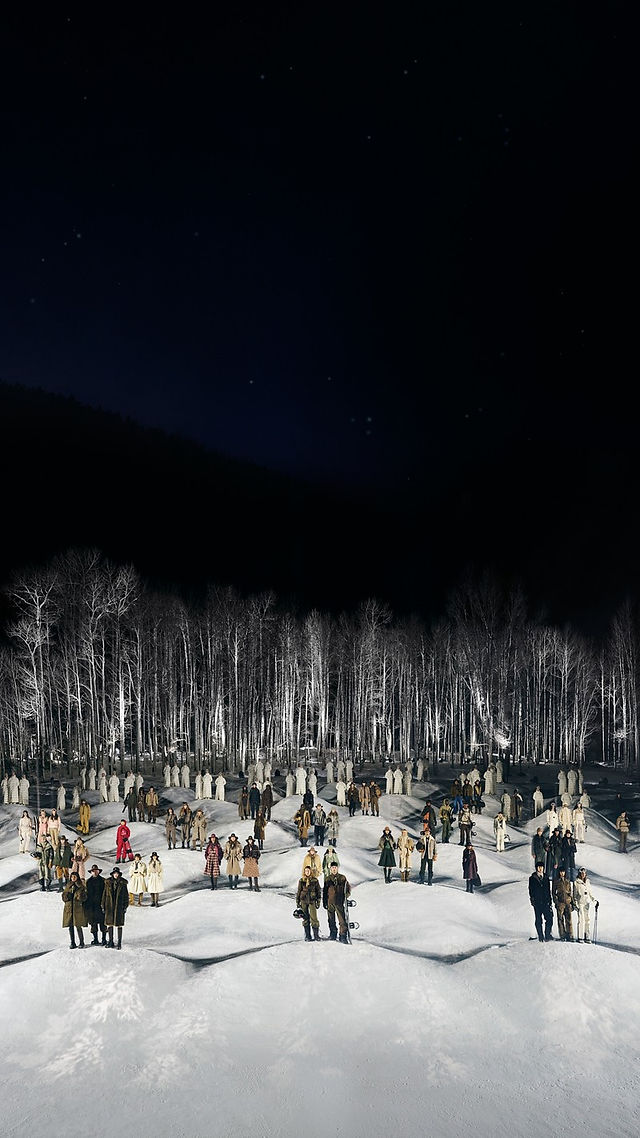


A stage can be visually stunning while creating too much distance between the people on it and the people watching. A sculptural intervention can transform a retail space while unintentionally becoming more memorable than the objects it was designed to frame. A dining environment can look extraordinary in photography while making conversation less natural or forcing guests to interact around the scenic design rather than with one another.
Scenic design should create the conditions for the experience, not become the experience itself.
Experiential design cannot be judged only by the quality of its individual components. This is the distinction between a good idea and the right idea. The experience has to be judged by the way those components influence behaviour, emotion and perception when they come together.
For luxury brands, that distinction becomes particularly important. An experience is rarely created simply to entertain. It may be designed to express something about the brand, deepen a client relationship, introduce a different perspective or move someone closer to the world behind the product. Scenic design therefore needs to support far more than the room. It needs to support the intention behind the experience.
Experiential Design needs freedom before discipline
A strong creative process needs room to explore the unexpected, challenge conventions and test ideas that may initially feel too ambitious, too unfamiliar or even slightly uncomfortable. That is often where the most distinctive work begins. The question at this stage is not yet what can be produced, but what the experience could become. Could the audience surround the stage instead of facing it? Could a retail environment reveal itself in chapters rather than all at once? Could food carry part of the narrative rather than simply accompany it? Could the arrival deliberately withhold the main experience? Could the smallest gesture become the emotional climax rather than the largest production moment?
This freedom matters because originality rarely comes from choosing the obvious route more elegantly. It comes from questioning the route itself. The familiar format may still be right, but it should never be right simply because it is familiar. Creative freedom, however, only creates value when it is followed by discipline. At a certain point, exploration has to become selection. More ideas no longer make the experience richer. They start making it less clear. This is where creative direction changes from opening possibilities to protecting the strongest one.
That transition is critical. The objective is not to reduce creative ambition, but to concentrate it. The clearer the central idea becomes, the easier it is to understand which elements are carrying it forward and which are simply occupying space around it.
Single moments don't exist in Experiential Design
There is another tendency in experiential design that deserves attention. The most visible part of an experience is often mistaken for the experience itself. The show becomes the experience. The dinner becomes the experience. The stage becomes the experience. The reveal becomes the experience. Wrong! The experience has already started long before the lights go down.
The invitation creates expectation. The way access is granted can establish a sense of relevance or exclusivity. The arrival sets the emotional tone. The welcome determines whether the guest immediately feels recognised or simply processed. The transition into the main space influences anticipation before anything has actually happened. And when the show ends, the experience should not simply disappear with it. The conversation afterwards, the departure, the final gesture, the follow-up and the way the relationship continues can determine whether an extraordinary moment becomes part of something larger or remains an isolated memory.
This is why the design needs to be considered across the full arc of before, during and after. The central moment may carry the greatest visual impact, but everything surrounding it gives that moment context and consequence. The before creates anticipation. The during delivers on it. The after determines what remains.
This continuity is particularly important because the objective is rarely simply attendance or entertainment. A beautifully executed show may create attention, but attention alone does not build a relationship. The experience needs to connect the visible moment to something larger: the brand world, the client relationship and what should happen next. A spectacular central moment surrounded by weak touchpoints is still a fragmented experience. It is the connections between those moments that determine whether an experience simply impresses or actually moves the relationship forward.
The real test of creative direction
The strongest experiences rarely feel like a collection of impressive creative elements. They feel like one thought unfolding through space, hospitality, storytelling, behaviour and emotion. The guest does not experience the stage, the lighting, the food, the service and the scenography as separate disciplines. They experience the result of all of them working together.
That is why creative direction ultimately comes down to judgement. Not how many ideas can be generated, but how clearly the strongest one can be protected. Not whether every element is beautiful in isolation, but whether each one contributes something meaningful to the experience as a whole.
This becomes increasingly important as luxury brands compete for the attention of clients who have already seen extraordinary places, performances, dinners and environments. Visual impact still matters, but it is becoming easier to create and harder to own. What remains difficult to replicate is an experience with a clear point of view, one that feels unmistakably connected to the brand and emotionally precise for the people inside it.
Sometimes that requires a spectacular creative gesture. Sometimes it requires removing the gesture altogether. The discipline is knowing the difference.
Because ultimately, the best experiences are not remembered because every element was beautiful. They are remembered because everything felt as though it belonged.
Beauty should never be the idea. It should be the consequence of a strong one.


Comments